
Cleaning methods compared
Four ways to clean reusable cups at the office
The reusable cup is rarely the problem. The process around it is. We put the four methods offices use side by side: what they do well, where they pinch, and what changes as soon as rinsing in between becomes possible.
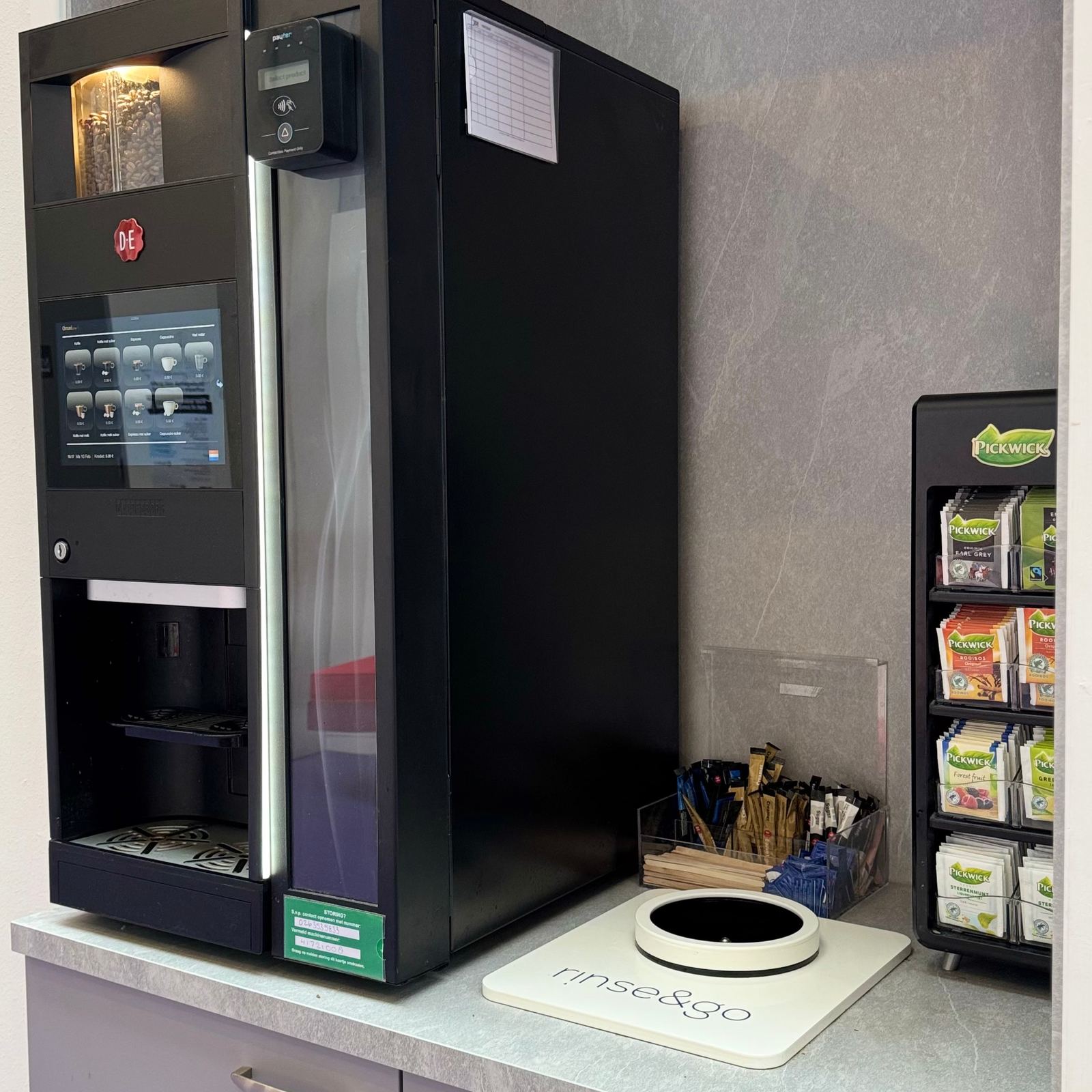
Sound familiar?
What goes wrong is rarely the cup itself
An organisation switches to reusables, and the bottleneck moves to the pantry.
Cups pile up
Used cups are left standing around desks, in meeting rooms and at the coffee machine.
Every cup is extra work
Whatever an employee puts down ends up with catering or the facility team.
Reuse tails off
If cleaning takes too much effort, people would rather take a fresh cup.
The costs keep running
Beyond buying the cups you pay for cleaning, for transport, and for the hours around it.
At a glance
The four methods side by side
Every method is good at something. The difference is in who does the work, how long an employee waits for their cup, and what that does to reuse.
| Method | Cup usable again | Who does the work | Effect on reuse |
|---|---|---|---|
| Dishwasher | 30 to 60 min.quick cycle | Employee and facility team | A fresh cup during the cycle |
| In-house wash-up | Depends on the washing round | Catering and wash-up | Handing in beats taking along |
| External collection service | Depends on the collection schedule | An external party | Handing in beats taking along |
| Under the tap | about 10 sec.plus the walk to the sink | The employee | Only if the tap is close by |
| Rinse&Go | 2 sec.at the pantry | The employee | The same cup comes back |
Method by method
What do you use today?
Pick the method closest to your situation. You then see what it does well, where it pinches, and what Rinse&Go adds to it.
Method 1
The dishwasher
The most common solution, mainly because it is already there. Someone puts their cup away, someone else loads and unloads, and a cycle runs at the end of the day.
What works well
- Usually already in the pantry and simple for anyone to use
- Suitable for crockery and cutlery, not just cups
- Cleans fully, with hot water and detergent
Where it pinches
- Loading and unloading gets left; nobody feels responsible for it
- A cycle takes a long time, so anyone wanting coffee in between takes a fresh cup
- Capacity in a pantry is limited, so cups pile up
- Every load costs hot water, electricity and detergent
What Rinse&Go adds here
Between one coffee and the next, the cup does not have to go into the dishwasher. That saves cups per day: less loading and unloading, less pile-up around a full machine, and a load that fits at the end of the day. The dishwasher keeps doing what it is meant for.
Method 2
The in-house wash-up kitchen
At larger sites, used cups go to a central wash-up kitchen. Employees hand them in, catering or a facility team does the rest.
What works well
- Employees are taken out of the process entirely
- Built for large volumes and for more than cups alone
- Consistent quality, because people do it every day
Where it pinches
- Collecting, washing, moving and returning costs logistics and hours
- Peaks around lunch come on top of the regular work
- Handing in is so easy that several cups per person per day becomes normal
- The cup only comes back after the washing round, not when you want it
What Rinse&Go adds here
Anyone who can rinse their cup at the pantry does not carry it to the collection crate after every coffee. Less goes through the central flow: fewer collection rounds, less handling, and a lower peak at the busiest moment.
Method 3
The external collection service
Cups go into a collection crate, an external party picks them up, cleans them elsewhere and returns clean cups.
What works well
- No extra workload for catering or the wash-up kitchen
- Works at sites without a washing facility of their own
- For the employee it is next to no effort
Where it pinches
- Handing in is easier than reusing, so cups per day go up
- Cups sit dirty in the crate for longer, so more of them are rejected
- You pay per cup, and that flow is not in your own hands
- Collecting, transporting and returning brings transport with it
What Rinse&Go adds here
If rinsing at the pantry is possible, there is less reason to hand in a cup after every coffee. Fewer cups per day means fewer journeys, fewer rejects, and an invoice that follows what is actually needed.
Method 4
Rinsing under the tap
The method that appears in no plan and is used most often in practice: a quick rinse at the sink.
What works well
- Immediate, with no waiting and nobody in between
- Nothing has to be installed or bought
- The cup goes straight back to the desk
Where it pinches
- The sink is rarely where the cup runs empty
- The worktop is left wet and messy
- Water use of about one litre per cup
What Rinse&Go adds here
This is the method Rinse&Go sits closest to, and the very points that fall short have been solved: it stands at the coffee machine instead of at the sink, it takes two seconds, the rinse water drains through the collection tray, and the side channels take the outer rim along. What that saves in water is below, with the calculation behind it.
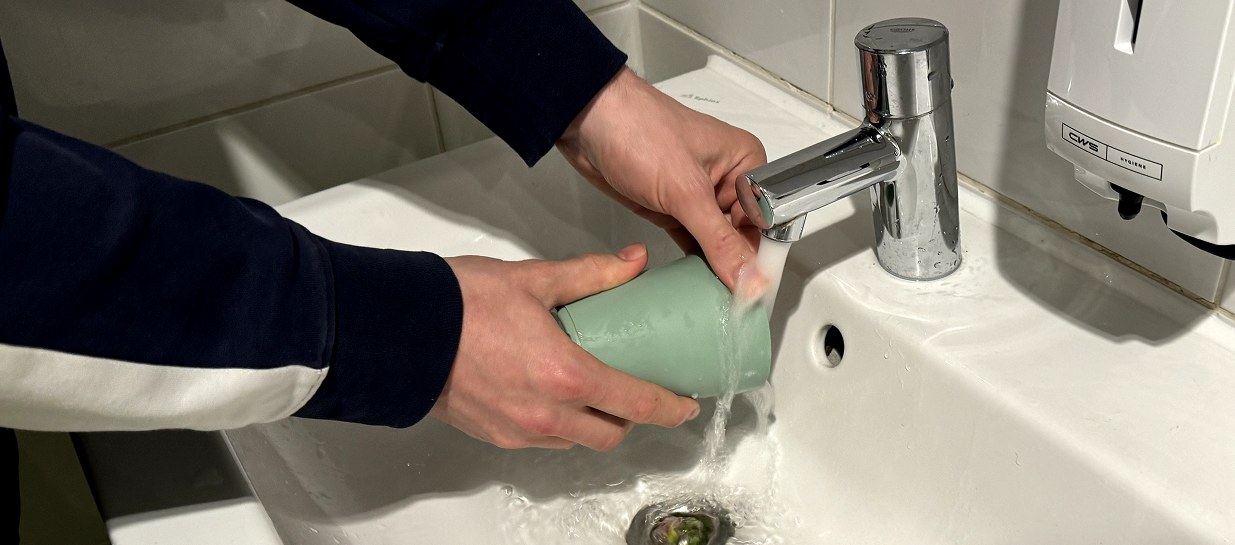
What happens today
In practice, the tap is the real alternative
Anyone wanting to rinse their cup in between usually has to rely on the tap. That tap is by no means always in the pantry, so employees have to walk around. The result: lost time, a wet worktop and about one litre of water used per cup.
Rinse&Go brings the rinsing moment to where the cup runs empty: right next to the coffee machine. Built into the countertop or free-standing on the floor, so there is a suitable solution for almost any location. A rinse takes about two seconds and uses up to 80% less water than rinsing under the tap.
The fifth way
Rinsing in between, where the cup runs empty
Rinse&Go replaces none of the methods above. It adds a step in front of them: the cup that would otherwise go straight to the dishwasher, the wash-up kitchen or the collection crate can simply come back with you.
Cup over the rinsing head
Place the used cup upside down over the rinsing point.
A short press
Press the cup down. The inside and the outer rim are rinsed clean in about two seconds.
Lift and done
The rinse water drains straight into the collection tray. The cup can go straight back to your desk with you.
What it saves
The figures, with the calculation behind them
Behind every figure is an info icon with the basis: what it is compared against, and on what grounds.
2 sec.
to rinse a cup
70%
less water than the dishwasher
80%
less water than under the tap
0 kWh
electricity per rinse
The biggest sustainability gain is not in the rinsing itself but in reuse: a reusable cup only earns back its production as the same cup is used more often.
In use at






In practice
What it delivers at sites where it is already in place
HEYDAY Integrated works successfully with Rinse&Go at several client sites. With its sustainable rinsing stations, this innovative start-up offers a practical way to clean reusable cups quickly and easily during the working day. Together we contribute to a more efficient workplace and to accelerating the move towards a circular economy, creating tangible impact for both people and the environment.
At ArtEZ we want staff and students to always be able to enjoy a clean cup, whether during work, a meeting or a coffee break. Rinse&Go offers us the ideal solution to rinse cups quickly and efficiently, even in places without a pantry.
Try it first
Measure what it does to your cup flow
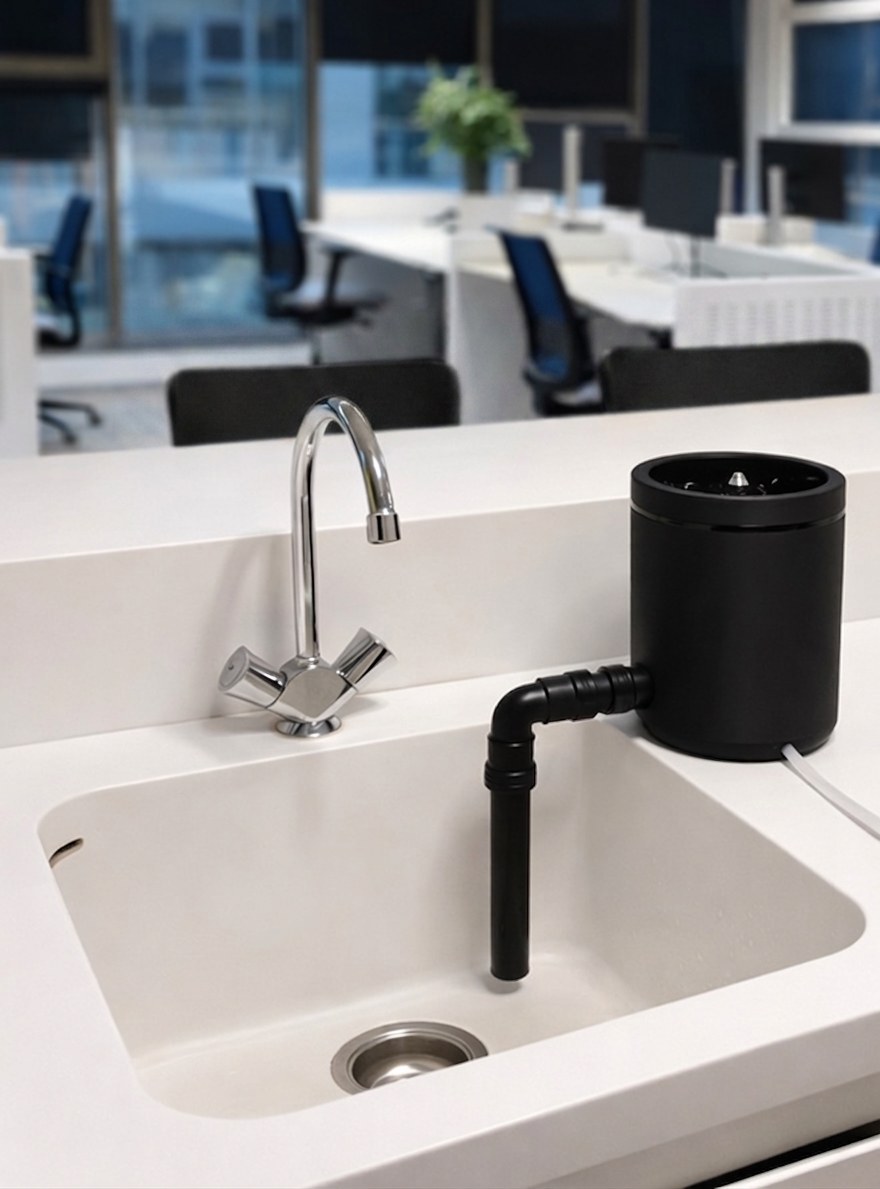
Whether rinsing in between works for you shows up fastest in practice. With the demo model that is possible without any changes to the pantry: it stands on top of the countertop next to a sink, and the rinse water runs into the basin through the drain hose.
- Four weeks, longer by agreement
- In a busy, logical spot, with a goal agreed in advance
- Only a water connection and a sink next to it are needed
- No notice period, stopping costs nothing extra
Book an introduction
Which method suits your pantry?
Tell us briefly what you have in place today and we will think along about what fits on top of it. We respond within two working days.
We look at what you have today
Which method you use, how many pantries there are, and where it gets stuck.
Demonstration on site
We show how the rinsing works and advise which set-up suits the space.
A pilot with a measurable goal
Four weeks with the demo model, with success criteria and an evaluation moment agreed in advance.
FAQ
Questions about cleaning and rinsing
Not seeing your question? Ask it through the form above.
Ask your questionWhat is the best way to clean reusable cups at the office?
There is no single best method, which is exactly why this page exists. For the full clean at the end of the day, a dishwasher or a wash-up kitchen is the most suitable. The bottleneck sits elsewhere: in the hours in between, when someone has just finished their coffee and wants to get on.
Whoever organises that moment well keeps the same cup in circulation for longer and has less to clean at the end of the day. A rinsing station at the coffee machine is meant for that; the other methods simply carry on alongside it.
Does Rinse&Go replace the dishwasher or the wash-up kitchen?
No. Rinsing is not hygienic cleaning and is not intended to be. A cup still needs a full wash regularly, and that keeps running the way it runs now.
What changes is the number of cups going through it each day. Fewer loads, fewer collection rounds and less pile-up in the pantry, without anything having to be removed from the existing approach.
Why not simply add a second dishwasher?
That solves capacity, but not waiting time. A cycle takes too long to get a cup back at the moment someone wants it, so a fresh one is taken anyway. The number of cups per employee per day stays the same.
On top of that, a second machine also has to be loaded and unloaded a second time, and that is precisely the work the complaints are about.
Is rinsing without detergent hygienic enough?
Rinsing with water alone is not hygienic cleaning, and we do not claim that it is. What it does do: remove taste and smell residues of milk, coffee and other drinks, so the next coffee does not taste of the last one. Alongside the rinsing point in the middle there are side channels that take the outer rim along, the place your lips touch.
The premise is therefore that someone reuses their own cup during the day. Do not put a rinsed cup back in the cupboard for a colleague, and have it cleaned fully at the end of the day.
Does it work with the cups and mugs we already have?
Yes. Anything up to 140 mm across fits, and there is no maximum height. Plastic, ceramic and glass all work, and on standard-sized mugs the handle simply sits next to it.
So there is no need for a new range of cups. The point is precisely that the cup someone already uses comes back with them more often.
What is needed to install a rinsing station?
A fixed connection to water and drainage, and nothing more: no socket is needed, because the rinse cycle runs on water pressure. The PantryRinser is built into the countertop, the PillarRinser stands free on the floor for spaces without a suitable worktop.
For a pilot even that is not necessary. The demo model stands loose on the countertop next to a sink and only needs a water connection.
What does it cost?
That depends on the number of rinsing stations, the chosen version and the situation on site, so we do not quote a standard price on the site. Renting is also possible; annual maintenance is included in that, a swap of the rinsing system.
In a short conversation we map out your situation and follow up with a tailored proposal.