
Office experiences
The 4 ways offices clean their reusable cups
March 18, 2026 | 4-minute read
Almost every large office has now switched to reusable cups. That choice is usually already made. The question is no longer if you do it, but how you organize it in a way that remains practical.
Ultimately, it comes down to one practical question: where and by whom are reusable cups cleaned? Do employees clean their own cup through a Bring Your Own Cup approach and rinse it at the tap, is it handled via the dishwasher in the pantry, organized internally through a central washing facility, or outsourced externally?
Whatever choice you make: cleaning has to happen somewhere within the organization. And that’s exactly where we see the same pattern emerge in many organizations: a dishwasher and pantry that no one truly feels responsible for, cups spreading across the workplace, rising cleaning costs, and increasing workload for cleaning staff, facility teams, and catering.
Each approach has its own advantages and considerations. In all cases, cleaning becomes a structural part of daily operations. As soon as the process doesn’t run smoothly, you notice it immediately: in the cleanliness of the workplace, in employee complaints, and in added pressure on cleaning, facility, or catering teams.
Organizations generally choose from four ways to organize cup cleaning. Placing them side by side makes it clear which approach best fits your situation.
Route 1: Bring Your Own Cup
Many organizations use a Bring Your Own Cup policy: employees use one fixed reusable cup or mug. This can be a personal cup or one provided by the employer.
The principle is clear: one cup per person, less waste, less disposable use. In practice, however, BYOC often introduces an extra layer of management.
What we commonly see in offices:
Cups are forgotten, lost, or left behind (on desks, in meeting rooms, pantries)
If a cup has been left overnight, employees experience a barrier in having to clean it before getting coffee
If their own cup is missing, employees are more likely to grab a visitor cup, increasing the total number of cups in circulation
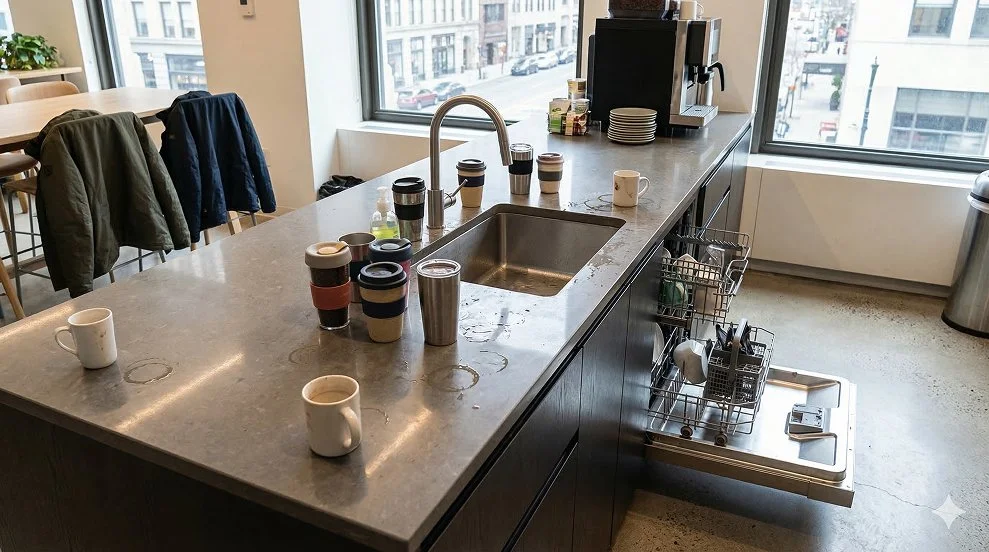
Cleaning often shifts to the most obvious place: the pantry tap. Employees “quickly rinse” (sometimes even in restrooms), turning the pantry into a rinsing area: wet countertops, coffee residue around sinks, and a space that quickly looks untidy. For cleaning teams, this often means extra rounds. And in terms of water use, it adds up: rinsing under the tap quickly exceeds one liter per rinse.
Route 2: Dishwasher in the pantry
The dishwasher feels like a logical solution for many offices because it’s familiar: dirty cups go in, clean cups come out later. In smaller environments, this can work well, especially when ownership is naturally taken.
In larger offices, however, the dishwasher often becomes a collection point rather than a solution:
Employees don’t feel responsible for loading and unloading
Dishwashers run mid-day, leaving cups sitting around in between
Cups pile up around the dishwasher, making the pantry look messy and less hygienic
Employees grab extra clean cups during the day if theirs is dirty, has been sitting too long, or if they switch drinks—causing cup volumes to increase
At higher volumes, you quickly need multiple dishwashers and more space, along with associated investment, maintenance, energy, and water costs. In short: as a periodic cleaning solution, a dishwasher works well, but for daily coffee moments under peak load, it’s often too slow and too dependent on ownership.
Route 3: External collection and washing service
Some organizations outsource cup cleaning. Employees return their cups at collection points, after which an external party collects, washes, dries, and returns them.
This often results in a cleaner workplace and removes the need for daily cleaning in the pantry.
Points to consider:
It only works well if there are enough conveniently located return points
It’s a structural cost (service + logistics)
Logistics become part of the process: collection frequency (often multiple times per week), storage, crates, and coordination
There is always some level of rejection: not every cup returns consistently “ready to use,” with drying often being the bottleneck
Route 4: Internal washing facility
In some organizations, cleaning is centralized: used cups are collected, washed in an internal washing facility, and then redistributed to pantries or serving points, often via catering.
Points to consider:
Structural labor costs: collecting, sorting, washing, drying, and redistributing requires continuous staff effort, which adds up quickly
Logistical complexity: collection points, routes, storage, and clear processes are essential
Higher cup consumption: when clean cups are always available, employees tend to grab a new one, increasing total usage
Inventory and peak demand: cups are temporarily out of circulation during washing and transport, requiring extra stock
Where Rinse&Go fits in
For facility teams, cleaning reusable cups is not just about sustainability—it’s about creating a process that works in daily practice.
Rinse&Go contributes in multiple ways. Within a Bring Your Own Cup setup, it offers employees a fast and easy way to rinse their cup between uses, making it easier to reuse throughout the day. At the same time, in environments where cups are processed via dishwashers, washing facilities, or external services, Rinse&Go reduces the number of cups entering the full cleaning cycle.
This makes reuse more practical while reducing pressure on pantries, cleaning teams, and logistics.
Did you find this blog interesting?
Then share it or read more of our stories
